Feb 5, 2026
Articles
What You Need to Know About "No Artificial Colors" Labeling Rules

Martín Ramírez
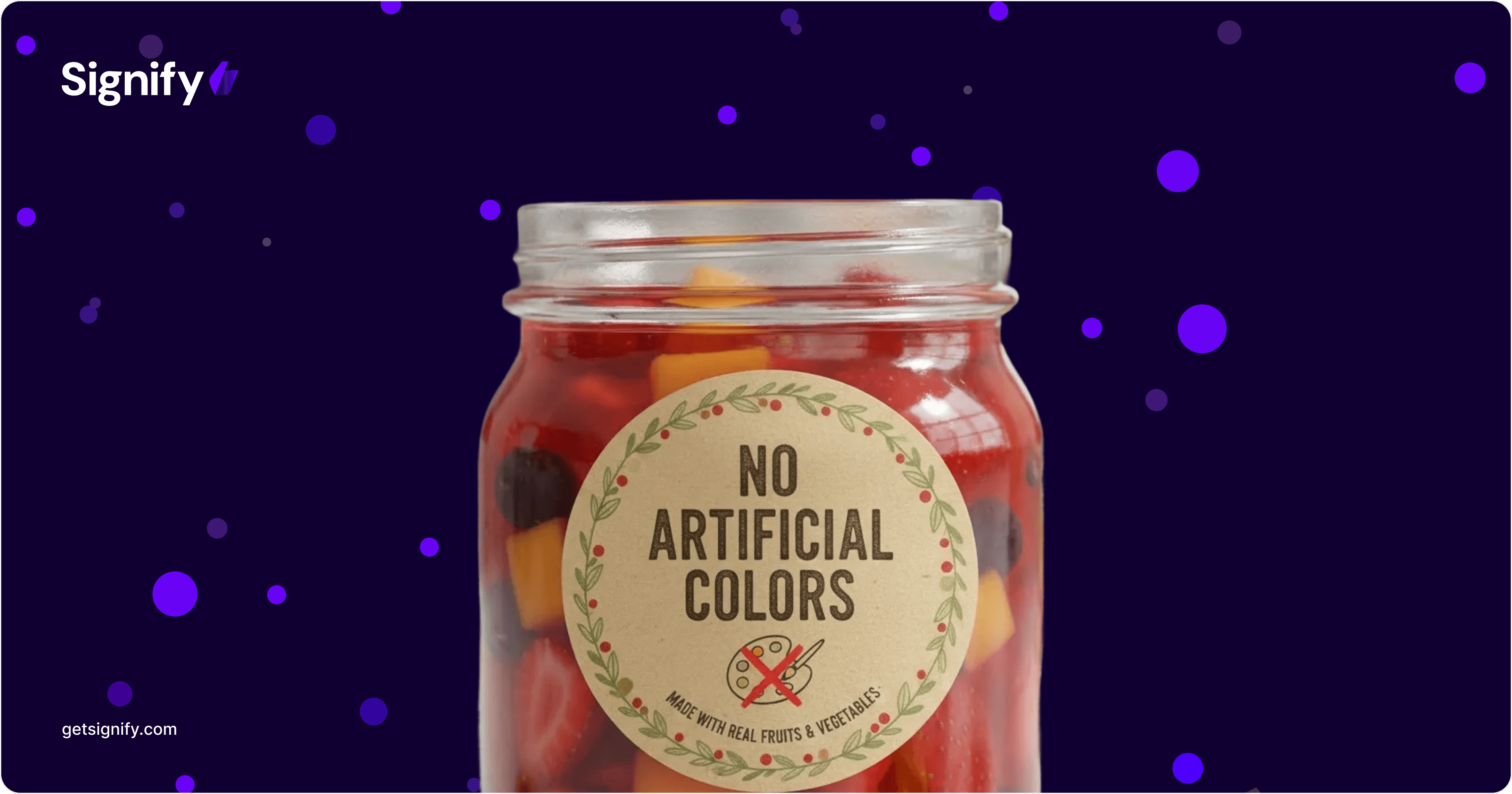
FDA's New "No Artificial Colors" Labeling Rules Just Changed the Game — And Created a Compliance Minefield
The agency's enforcement discretion policy removes one barrier for reformulating brands — but introduces new regulatory ambiguity that compliance teams need to navigate carefully.
On February 5, 2026, the FDA sent a letter to food manufacturers announcing it will exercise enforcement discretion on "no artificial colors" labeling claims — effectively loosening rules that had prevented companies from using the label even when their products contained only naturally derived colorants.
The change sounds simple. It isn't.
For compliance teams already navigating the turbulent waters of the synthetic dye phase-out, this policy shift introduces new flexibility alongside new uncertainty. And with the voluntary end-of-2026 deadline for eliminating petroleum-based dyes from the U.S. food supply looming, the timing could not be more consequential.
What Actually Changed
Under the FDA's previous interpretation, all color additives — whether derived from beets, spirulina, or a petroleum refinery — were considered "artificial" for labeling purposes. This meant a brand that had already reformulated away from synthetic dyes like Red No. 40 or Yellow No. 5 and replaced them with plant-derived alternatives still couldn't tell consumers its product contained "no artificial colors."
That regulatory catch-22 is now gone. The FDA will permit three specific voluntary labeling claims on products that do not contain any certified FD&C synthetic colors listed under 21 CFR Part 74:
"Made without artificial food colors/colorings"
"No artificial color/colors/coloring"
"No added artificial color/colors/coloring"
The agency framed this as both a consumer clarity measure and an incentive for reformulation. FDA Commissioner Marty Makary put it directly: calling colors derived from natural sources "artificial" was "confusing for consumers and a hindrance for companies to explore alternative food coloring options."
This is enforcement discretion, not rulemaking. The FDA isn't amending the Code of Federal Regulations. It's signaling that it won't take enforcement action against companies that make these claims — provided their products are free of petroleum-based certified colors.
The Compliance Implications Are More Complex Than They Appear
For regulatory affairs managers and compliance lawyers, the devil is in the details — and several significant details remain unresolved.
"Petroleum-based dyes" is not a recognized regulatory category.[ Sarah Sorscher, director of regulatory affairs at the Center for Science in the Public Interest (CSPI), raised this concern immediately. The FDA's existing framework divides color additives](https://www.getsignify.com/21-cfr/part-101-section-101-22) into "certified" (synthetic FD&C colors that require batch certification) and "non-certified" (exempt from certification, including many naturally derived options). The term "petroleum-based" doesn't map neatly onto either category.
This matters because some non-certified color additives, like titanium dioxide, are not petroleum-based but have been linked to health concerns significant enough to prompt a ban in the European Union. Under the new policy, a product containing titanium dioxide could potentially carry a "no artificial colors" claim — which is technically accurate under the FDA's enforcement discretion framework but could expose companies to consumer litigation for misleading labeling.
[As Sorscher warned, "Companies can be sued by their customers for false or misleading claims on food labels](https://www.getsignify.com/blog/the-complete-guide-to-fda-food-labeling), so they will likely need more clarity from FDA — and perhaps a more permanent change in the law — before actually making these declarations."
Self-certification shifts compliance risk to manufacturers. Unlike certified synthetic dyes, which the FDA oversees through a batch certification process, companies using naturally derived color additives must self-certify that their colors are safe. Paul Manning, CEO of color manufacturer Sensient Technologies, underscored the practical significance: natural colors can contain contaminants or be processed in ways that "may introduce harmful substances." The burden of ensuring safety and purity now sits squarely on the manufacturer.
The FDA acknowledged this reality by simultaneously issuing a separate letter reminding manufacturers of their responsibility to limit impurities such as heavy metals and to comply with identity and purity requirements for certification-exempt color additives. That reminder was not coincidental.
Enforcement discretion is not permanent protection. This policy can be reversed, modified, or superseded by formal rulemaking at any time. Companies that invest in labeling changes based solely on this discretionary position are building on a foundation that could shift. Compliance teams should document their reliance on this guidance carefully and monitor for any formal rulemaking that could establish — or restrict — these claims more permanently.
The Broader Context: A Patchwork of Pressure
This labeling policy doesn't exist in isolation. It's one piece of a rapidly accelerating regulatory landscape that's creating compliance challenges at every level.
The federal timeline. In April 2025, HHS and the FDA announced plans to phase out all petroleum-based synthetic dyes from the U.S. food supply by the end of 2026. The six targeted dyes — Red No. 40, Yellow No. 5, Yellow No. 6, Blue No. 1, Blue No. 2, and Green No. 3 — are widely used across thousands of processed food products. The FDA has also initiated formal revocation proceedings for two rarely used colors, Citrus Red No. 2 and Orange B, and is pushing companies to remove Red No. 3 ahead of its formal January 2027 deadline.
Critically, this federal effort relies on voluntary compliance. HHS Secretary Robert F. Kennedy Jr. has acknowledged there is no formal agreement with food companies — only "an understanding." That ambiguity has left manufacturers in a difficult position: the federal government is asking for voluntary action while state governments are increasingly mandating it.
The state-level patchwork.[ Over 30 states have proposed or passed legislation targeting artificial food colors. California has banned six synthetic dyes from school foods and prohibited Red No. 3 and three other additives from foods sold statewide. Texas has passed laws banning certain additives in school meals and is considering legislation that would require warning labels](https://www.getsignify.com/blog/texas-food-warning-labels) on products containing any FDA-certified synthetic colors. West Virginia's broad restrictions began taking effect in August 2025. Similar laws are pending in Louisiana, Missouri, and elsewhere.
For multi-state manufacturers, this patchwork creates what legal analysts at Mayer Brown have described as a near-certain increase in consumer class actions related to the safety and alleged health effects of synthetic dyes — and a labeling environment where marketing updates themselves can create liability. The Texas Attorney General's investigation into WK Kellogg Co. for marketing cereals as "healthy" while containing petroleum-based dyes illustrates how reformulation messaging can backfire.
New natural color options are expanding. Alongside the labeling policy, the FDA approved beetroot red as a new certification-exempt color additive and expanded the permitted uses of spirulina extract. These join Galdieria extract blue, butterfly pea flower extract, and calcium phosphate — all fast-tracked for approval in 2025. The total number of recently approved natural color options now stands at six, giving formulators more alternatives. But as industry groups like the International Association of Color Manufacturers have cautioned, natural alternatives present their own challenges around supply chain stability, color consistency, shelf life, and cost.
What Compliance Teams Should Do Now
This policy shift requires a measured response — neither ignoring the opportunity nor rushing to capitalize on it without adequate safeguards.
Audit your color additive inventory.[ Identify every SKU and formulation containing certified FD&C synthetic colors (21 CFR Part 74). Separately flag any non-certified color additives that could be problematic under the new framework — particularly titanium dioxide and any other additives with disputed safety profiles. Your reformulation](https://www.getsignify.com/food-formulation) roadmap should account for both categories.
Assess labeling changes against litigation risk, not just FDA enforcement risk. The FDA's enforcement discretion protects you from agency action, not from class action lawsuits. Before adopting any "no artificial colors" claims, evaluate whether your full ingredient list — including processing aids, sub-ingredients, and color additives exempt from certification — can withstand consumer scrutiny under state consumer protection laws. This analysis should involve both regulatory affairs and legal counsel.
Document your compliance rationale. If you choose to adopt the new labeling claims, create a compliance file documenting which FDA guidance you relied on, how you determined your products qualify, and what quality controls you have in place for naturally derived color additives. This documentation will be critical if the policy changes or if you face legal challenges.
Monitor the state landscape actively.[ The federal enforcement discretion policy doesn't preempt state laws. If you're selling into California, Texas, West Virginia, or any of the other states with active or pending artificial color legislation, your labeling must comply with the most restrictive applicable requirements. Tracking these moving targets in real-time requires either dedicated regulatory intelligence resources or automated compliance monitoring tools](https://www.getsignify.com/blog/compliance-monitoring-tools).
Prepare for supply chain disruption. If your reformulation timeline depends on newly approved natural colorants like beetroot red or expanded spirulina extract, validate your supply chain now. Natural color suppliers are facing unprecedented demand as thousands of products reformulate simultaneously. Lead times, pricing, and batch-to-batch consistency will be ongoing challenges.
The Bigger Picture
The FDA's labeling policy is a carrot designed to accelerate the industry's transition away from synthetic dyes. It removes a genuine barrier — the absurdity of calling a beet-derived color "artificial" — while creating market incentive for companies that have already reformulated.
But it's also a policy built on enforcement discretion rather than formal rulemaking, deployed alongside a voluntary compliance framework that state governments are rapidly outpacing with mandatory requirements. For compliance professionals, the core challenge hasn't changed: you're operating in a regulatory environment where the goalposts are moving at the federal, state, and international levels simultaneously.
The companies that will navigate this transition successfully are those treating it not as a one-time labeling update but as a sustained compliance program — one that integrates ingredient reformulation, label review, supply chain management, regulatory monitoring, and legal risk assessment into a coordinated effort.
The "no artificial colors" label just got easier to use. Making sure you're using it correctly — and safely — is another matter entirely.
This article is for informational purposes only and does not constitute legal or regulatory advice. Companies should consult with qualified regulatory affairs professionals and legal counsel regarding their specific compliance obligations.
Sources:
U.S. Department of Health and Human Services, "FDA Takes New Approach to 'No Artificial Colors' Claims," February 5, 2026.
U.S. Food and Drug Administration, "Letter to the Food Industry on 'No Artificial Colors' Labeling Claims," February 5, 2026.
U.S. Food and Drug Administration, "FDA Reminds Manufacturers of Color Additives Exempt from Certification to Comply with Identity and Purity Requirements," February 5, 2026.
Food Dive, "FDA loosens rules for 'no artificial colors' label in food," February 5, 2026.
FoodNavigator-USA, "FDA eases 'no artificial colors' labeling rules, paves way for natural color adoption," February 5, 2026.
National Law Review / Keller and Heckman LLP, "FDA Announces Update to 'No Artificial Colors' Claims, Approves Two Color Additive Petitions," February 5, 2026.
Mayer Brown, "HHS and FDA Announce Plans to Phase out Synthetic Food Dyes," May 2025.
Center for Science in the Public Interest, "Synthetic Dyes Corporate Commitment Tracker."
FDA's New "No Artificial Colors" Labeling Rules Just Changed the Game — And Created a Compliance Minefield
The agency's enforcement discretion policy removes one barrier for reformulating brands — but introduces new regulatory ambiguity that compliance teams need to navigate carefully.
On February 5, 2026, the FDA sent a letter to food manufacturers announcing it will exercise enforcement discretion on "no artificial colors" labeling claims — effectively loosening rules that had prevented companies from using the label even when their products contained only naturally derived colorants.
The change sounds simple. It isn't.
For compliance teams already navigating the turbulent waters of the synthetic dye phase-out, this policy shift introduces new flexibility alongside new uncertainty. And with the voluntary end-of-2026 deadline for eliminating petroleum-based dyes from the U.S. food supply looming, the timing could not be more consequential.
What Actually Changed
Under the FDA's previous interpretation, all color additives — whether derived from beets, spirulina, or a petroleum refinery — were considered "artificial" for labeling purposes. This meant a brand that had already reformulated away from synthetic dyes like Red No. 40 or Yellow No. 5 and replaced them with plant-derived alternatives still couldn't tell consumers its product contained "no artificial colors."
That regulatory catch-22 is now gone. The FDA will permit three specific voluntary labeling claims on products that do not contain any certified FD&C synthetic colors listed under 21 CFR Part 74:
"Made without artificial food colors/colorings"
"No artificial color/colors/coloring"
"No added artificial color/colors/coloring"
The agency framed this as both a consumer clarity measure and an incentive for reformulation. FDA Commissioner Marty Makary put it directly: calling colors derived from natural sources "artificial" was "confusing for consumers and a hindrance for companies to explore alternative food coloring options."
This is enforcement discretion, not rulemaking. The FDA isn't amending the Code of Federal Regulations. It's signaling that it won't take enforcement action against companies that make these claims — provided their products are free of petroleum-based certified colors.
The Compliance Implications Are More Complex Than They Appear
For regulatory affairs managers and compliance lawyers, the devil is in the details — and several significant details remain unresolved.
"Petroleum-based dyes" is not a recognized regulatory category.[ Sarah Sorscher, director of regulatory affairs at the Center for Science in the Public Interest (CSPI), raised this concern immediately. The FDA's existing framework divides color additives](https://www.getsignify.com/21-cfr/part-101-section-101-22) into "certified" (synthetic FD&C colors that require batch certification) and "non-certified" (exempt from certification, including many naturally derived options). The term "petroleum-based" doesn't map neatly onto either category.
This matters because some non-certified color additives, like titanium dioxide, are not petroleum-based but have been linked to health concerns significant enough to prompt a ban in the European Union. Under the new policy, a product containing titanium dioxide could potentially carry a "no artificial colors" claim — which is technically accurate under the FDA's enforcement discretion framework but could expose companies to consumer litigation for misleading labeling.
[As Sorscher warned, "Companies can be sued by their customers for false or misleading claims on food labels](https://www.getsignify.com/blog/the-complete-guide-to-fda-food-labeling), so they will likely need more clarity from FDA — and perhaps a more permanent change in the law — before actually making these declarations."
Self-certification shifts compliance risk to manufacturers. Unlike certified synthetic dyes, which the FDA oversees through a batch certification process, companies using naturally derived color additives must self-certify that their colors are safe. Paul Manning, CEO of color manufacturer Sensient Technologies, underscored the practical significance: natural colors can contain contaminants or be processed in ways that "may introduce harmful substances." The burden of ensuring safety and purity now sits squarely on the manufacturer.
The FDA acknowledged this reality by simultaneously issuing a separate letter reminding manufacturers of their responsibility to limit impurities such as heavy metals and to comply with identity and purity requirements for certification-exempt color additives. That reminder was not coincidental.
Enforcement discretion is not permanent protection. This policy can be reversed, modified, or superseded by formal rulemaking at any time. Companies that invest in labeling changes based solely on this discretionary position are building on a foundation that could shift. Compliance teams should document their reliance on this guidance carefully and monitor for any formal rulemaking that could establish — or restrict — these claims more permanently.
The Broader Context: A Patchwork of Pressure
This labeling policy doesn't exist in isolation. It's one piece of a rapidly accelerating regulatory landscape that's creating compliance challenges at every level.
The federal timeline. In April 2025, HHS and the FDA announced plans to phase out all petroleum-based synthetic dyes from the U.S. food supply by the end of 2026. The six targeted dyes — Red No. 40, Yellow No. 5, Yellow No. 6, Blue No. 1, Blue No. 2, and Green No. 3 — are widely used across thousands of processed food products. The FDA has also initiated formal revocation proceedings for two rarely used colors, Citrus Red No. 2 and Orange B, and is pushing companies to remove Red No. 3 ahead of its formal January 2027 deadline.
Critically, this federal effort relies on voluntary compliance. HHS Secretary Robert F. Kennedy Jr. has acknowledged there is no formal agreement with food companies — only "an understanding." That ambiguity has left manufacturers in a difficult position: the federal government is asking for voluntary action while state governments are increasingly mandating it.
The state-level patchwork.[ Over 30 states have proposed or passed legislation targeting artificial food colors. California has banned six synthetic dyes from school foods and prohibited Red No. 3 and three other additives from foods sold statewide. Texas has passed laws banning certain additives in school meals and is considering legislation that would require warning labels](https://www.getsignify.com/blog/texas-food-warning-labels) on products containing any FDA-certified synthetic colors. West Virginia's broad restrictions began taking effect in August 2025. Similar laws are pending in Louisiana, Missouri, and elsewhere.
For multi-state manufacturers, this patchwork creates what legal analysts at Mayer Brown have described as a near-certain increase in consumer class actions related to the safety and alleged health effects of synthetic dyes — and a labeling environment where marketing updates themselves can create liability. The Texas Attorney General's investigation into WK Kellogg Co. for marketing cereals as "healthy" while containing petroleum-based dyes illustrates how reformulation messaging can backfire.
New natural color options are expanding. Alongside the labeling policy, the FDA approved beetroot red as a new certification-exempt color additive and expanded the permitted uses of spirulina extract. These join Galdieria extract blue, butterfly pea flower extract, and calcium phosphate — all fast-tracked for approval in 2025. The total number of recently approved natural color options now stands at six, giving formulators more alternatives. But as industry groups like the International Association of Color Manufacturers have cautioned, natural alternatives present their own challenges around supply chain stability, color consistency, shelf life, and cost.
What Compliance Teams Should Do Now
This policy shift requires a measured response — neither ignoring the opportunity nor rushing to capitalize on it without adequate safeguards.
Audit your color additive inventory.[ Identify every SKU and formulation containing certified FD&C synthetic colors (21 CFR Part 74). Separately flag any non-certified color additives that could be problematic under the new framework — particularly titanium dioxide and any other additives with disputed safety profiles. Your reformulation](https://www.getsignify.com/food-formulation) roadmap should account for both categories.
Assess labeling changes against litigation risk, not just FDA enforcement risk. The FDA's enforcement discretion protects you from agency action, not from class action lawsuits. Before adopting any "no artificial colors" claims, evaluate whether your full ingredient list — including processing aids, sub-ingredients, and color additives exempt from certification — can withstand consumer scrutiny under state consumer protection laws. This analysis should involve both regulatory affairs and legal counsel.
Document your compliance rationale. If you choose to adopt the new labeling claims, create a compliance file documenting which FDA guidance you relied on, how you determined your products qualify, and what quality controls you have in place for naturally derived color additives. This documentation will be critical if the policy changes or if you face legal challenges.
Monitor the state landscape actively.[ The federal enforcement discretion policy doesn't preempt state laws. If you're selling into California, Texas, West Virginia, or any of the other states with active or pending artificial color legislation, your labeling must comply with the most restrictive applicable requirements. Tracking these moving targets in real-time requires either dedicated regulatory intelligence resources or automated compliance monitoring tools](https://www.getsignify.com/blog/compliance-monitoring-tools).
Prepare for supply chain disruption. If your reformulation timeline depends on newly approved natural colorants like beetroot red or expanded spirulina extract, validate your supply chain now. Natural color suppliers are facing unprecedented demand as thousands of products reformulate simultaneously. Lead times, pricing, and batch-to-batch consistency will be ongoing challenges.
The Bigger Picture
The FDA's labeling policy is a carrot designed to accelerate the industry's transition away from synthetic dyes. It removes a genuine barrier — the absurdity of calling a beet-derived color "artificial" — while creating market incentive for companies that have already reformulated.
But it's also a policy built on enforcement discretion rather than formal rulemaking, deployed alongside a voluntary compliance framework that state governments are rapidly outpacing with mandatory requirements. For compliance professionals, the core challenge hasn't changed: you're operating in a regulatory environment where the goalposts are moving at the federal, state, and international levels simultaneously.
The companies that will navigate this transition successfully are those treating it not as a one-time labeling update but as a sustained compliance program — one that integrates ingredient reformulation, label review, supply chain management, regulatory monitoring, and legal risk assessment into a coordinated effort.
The "no artificial colors" label just got easier to use. Making sure you're using it correctly — and safely — is another matter entirely.
This article is for informational purposes only and does not constitute legal or regulatory advice. Companies should consult with qualified regulatory affairs professionals and legal counsel regarding their specific compliance obligations.
Sources:
U.S. Department of Health and Human Services, "FDA Takes New Approach to 'No Artificial Colors' Claims," February 5, 2026.
U.S. Food and Drug Administration, "Letter to the Food Industry on 'No Artificial Colors' Labeling Claims," February 5, 2026.
U.S. Food and Drug Administration, "FDA Reminds Manufacturers of Color Additives Exempt from Certification to Comply with Identity and Purity Requirements," February 5, 2026.
Food Dive, "FDA loosens rules for 'no artificial colors' label in food," February 5, 2026.
FoodNavigator-USA, "FDA eases 'no artificial colors' labeling rules, paves way for natural color adoption," February 5, 2026.
National Law Review / Keller and Heckman LLP, "FDA Announces Update to 'No Artificial Colors' Claims, Approves Two Color Additive Petitions," February 5, 2026.
Mayer Brown, "HHS and FDA Announce Plans to Phase out Synthetic Food Dyes," May 2025.
Center for Science in the Public Interest, "Synthetic Dyes Corporate Commitment Tracker."
The information presented is for educational and informational purposes only and should not be construed as legal, regulatory, or professional advice. Organizations should consult with qualified legal and compliance professionals for guidance specific to their circumstances.
What You Need to Know About "No Artificial Colors" Labeling Rules
Feb 5, 2026