Mar 11, 2026
Articles
Navigating CPG Product Compliance in 2026

Martín Ramírez
Streamlining Risk Management in CPG Compliance
Understanding the Challenges of Compliance
There is a question that sits underneath nearly every compliance review, rarely asked out loud but always present: if we don't fix this, what actually happens?
For most compliance teams, answering it means leaving the review. It means pulling someone away to search for relevant enforcement history, cross-referencing warning letters, or relying on whoever in the organization has been around long enough to remember a similar situation. Sometimes that institutional knowledge exists. Often it doesn't. And when it doesn't, the answer defaults to a best guess dressed up as professional judgment.
This is not a failure of the compliance team. It is a failure of the tools they have been given. Compliance software has historically been very good at telling teams what is wrong and very poor at helping them understand why it matters. Regulatory intelligence platforms have tried to fill that gap, but, as we will see, they have largely created a different problem rather than solving the original one.
Signify's Regulatory Intelligence capability changes the calculus entirely. For the first time, enforcement context is built directly into the compliance review — not as a separate research task, not as a content feed to monitor, but as live intelligence mapped automatically to the specific obligations your products are being reviewed against. This post explains what that means, why it matters for CPG brands, and why the traditional approach to regulatory intelligence has run out of road.
The Real Job of a Compliance Review
A compliance review is, at its core, a risk management exercise. When a compliance professional reviews a product label, a formula, or a marketing claim, they are doing two things simultaneously: assessing whether the product meets a given obligation, and forming a judgment about the consequences of non-conformance.
The first task — does this product meet the requirement? — is the one compliance software was built to support. Validations, document comparisons, structured workflows. These are tractable problems, and the category has gotten reasonably good at them.
The second task — what happens if it doesn't? — has been left largely to the individual. And that asymmetry has real costs.
When an issue is flagged without context for consequences, the team faces a prioritization problem. Not every compliance gap carries equal weight. A missing allergen statement is a different order of risk than a font size that falls slightly below spec. But without enforcement data, both show up as findings. The judgment call about which to escalate, which to remediate first, and how hard to push back against a product team that wants to move fast falls entirely on the reviewer's shoulders, supported by whatever they know or can quickly find.
That burden compounds. Compliance teams at CPG brands manage product portfolios across multiple markets, with varying regulatory frameworks and risk profiles. Asking individuals to carry the enforcement knowledge for it all — while also completing reviews at the pace the business requires — is an unsustainable expectation.
What Regulatory Intelligence Actually Means for CPG Brands
The term "regulatory intelligence" has been used loosely enough in the industry that it has lost some of its meaning. For most platforms, it describes access to regulatory content: updates to guidance documents, new rulemakings, agency announcements, and enforcement actions as they are published. Valuable raw material. But raw material nonetheless.
For CPG brands specifically, the regulatory landscape is unusually broad. Food and beverage brands navigate FDA labeling requirements, FTC advertising guidelines, state-level regulations, and retailer-specific compliance requirements simultaneously. Dietary supplement brands layer on structure/function claim rules, third-party certification requirements, and a patchwork of international market access obligations. Cosmetics brands face evolving ingredient restrictions, safety substantiation requirements, and a regulatory environment that has grown significantly more complex in recent years.
The enforcement activity across these categories is substantial. The FDA issues hundreds of warning letters annually across the food, cosmetics, and dietary supplement sectors. Recalls initiated across CPG product categories number in the thousands each year. FTC enforcement actions targeting unsubstantiated health and marketing claims have increased in frequency and visibility. Class action litigation targeting labeling and claims issues has become an industry-wide cost of doing business for brands that operate at scale.
All of that enforcement activity tells a story. It tells teams which types of violations regulators prioritize. It tells them how quickly an unaddressed issue can escalate from a warning letter to a recall. It tells them which claims have attracted litigation, which ingredient disclosures have been contested in court, and which labeling patterns have drawn agency attention.
That story is enormously valuable. The problem has always been accessing it at the right moment — within the review, mapped to the specific obligation being evaluated — rather than as a research task that occurs separately, if at all.
How Signify's Regulatory Intelligence Works
Signify's Regulatory Intelligence is built around a straightforward yet consequential idea: the compliance review and the enforcement record should exist in the same place, automatically mapped to each other.
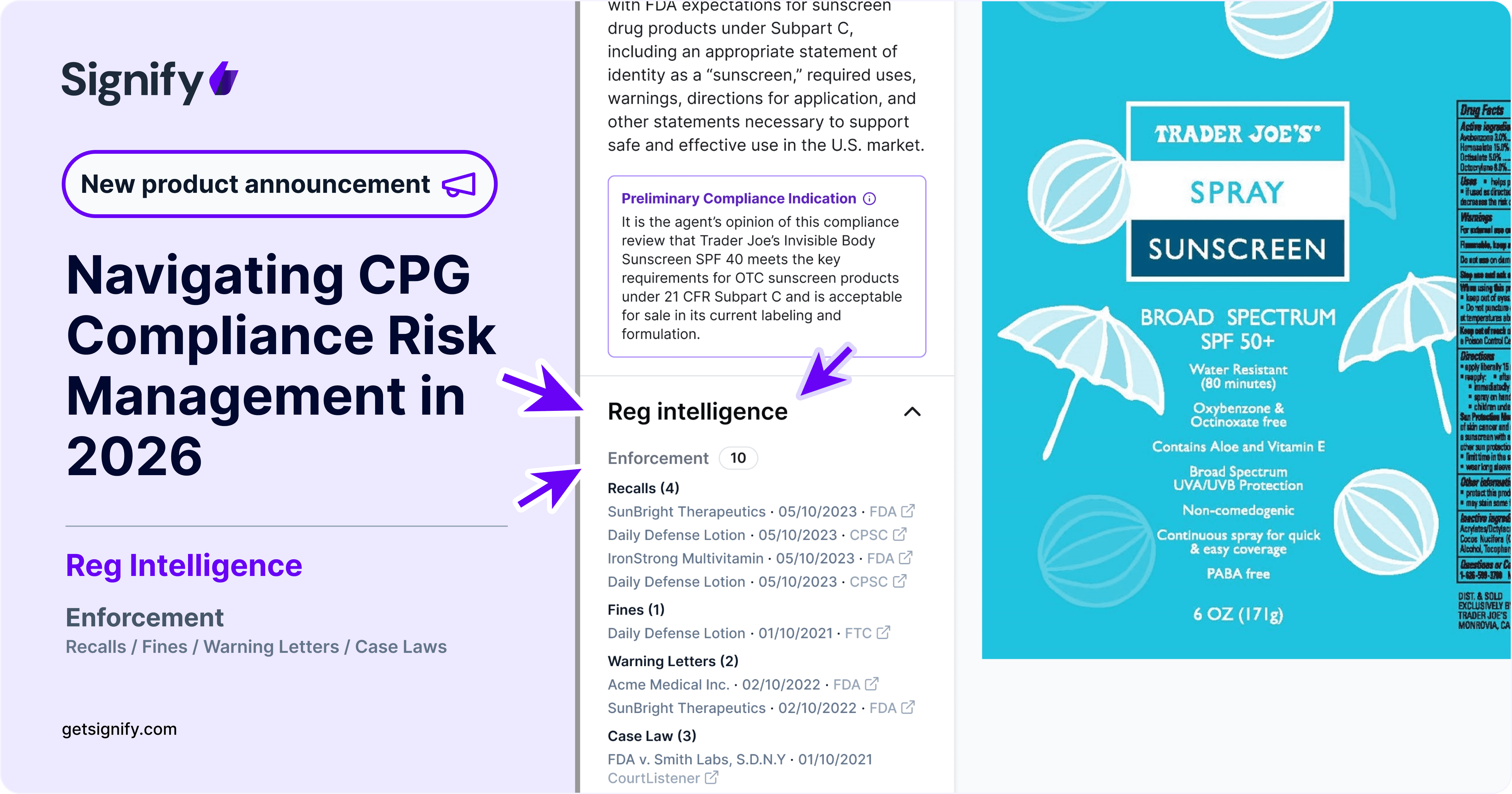
In Signify, every compliance review is structured around a checklist — a set of specific obligations a product must meet for a given market or retailer. Regulatory Intelligence extends that foundation. Signify agents continuously monitor enforcement activity across FDA, FTC, CPSC, and court records, then map what they find to the obligations in your checklists and the products under review.
When a review surfaces a finding, the relevant enforcement context surfaces with it. That means:
Recalls tied to the same obligation type, showing which brands have had products pulled from the market and the circumstances under which they were pulled.
Warning Letters issued to companies for the same category of non-conformance, including the agency's language and the required remediation.
Fines levied by regulatory bodies provide a concrete picture of financial exposure.
Case Law from federal and state courts, showing how labeling and claims disputes have played out when enforcement escalated to litigation.
Each item is sourced and linked directly to the original document. The agent does the research. The reviewer gets the context.
Critically, none of this requires any action from the compliance team. There are no feeds to subscribe to, no searches to run, no reports to pull. The intelligence is embedded in the workflow rather than sitting adjacent to it.
Why Enforcement Context Changes How Teams Work
The practical effect of having enforcement context inside the review is not marginal. It reshapes how compliance professionals do their jobs across three dimensions.
Prioritization becomes defensible. When a review produces ten findings, the question of where to start is no longer purely subjective. A finding tied to four recalls and two warning letters in the same category carries documented weight. A finding with no enforcement history can be treated accordingly. The reviewer is not guessing at severity — they are drawing on the actual record of how regulators and courts have responded to equivalent issues.
Escalation becomes easier. One of the consistent frustrations compliance professionals describe is the difficulty of conveying urgency to stakeholders who are not close to the regulatory environment. Product teams want to move fast. Marketing teams want to preserve the claim. Legal wants to understand exposure before committing resources. All of those conversations go differently when the compliance team can present the enforcement record alongside the finding rather than asking stakeholders to take their word for the risk level.
Coverage becomes broader without expanding capacity. A compliance team can only carry so much institutional knowledge. People leave organizations, categories evolve, and the enforcement record continues to grow. A system that automatically surfaces relevant precedent extends the team's effective knowledge without adding headcount or requiring individuals to maintain an ever-growing personal database of enforcement history.
The Demise of Legacy Regulatory Intelligence Platforms
It is worth addressing directly what has passed for regulatory intelligence in the industry, because the contrast matters.
Legacy regulatory intelligence platforms — the content-feed model that has defined the category for decades — were built on a reasonable premise: compliance teams need to stay current on regulatory developments, so give them a centralized place to receive that information. Monitoring services, alert subscriptions, curated content libraries, and jurisdiction-specific update feeds. The better platforms organized this content, made it searchable, and layered on some categorization to help users filter by topic or agency.
The problem was never the data. The problem was the workflow it created.
Every piece of content delivered by a regulatory intelligence platform requires a human being to read it, evaluate its relevance to their specific products and markets, connect it to the obligations they manage, and decide whether it changes how they work. That is the hard part. And the platforms were never designed to do it. They delivered the raw material and left the analysis to the subscriber.
The result, predictably, was information overload. Compliance professionals describe the experience of managing regulatory content feeds the way people describe managing email: a sense that staying on top of it is a full-time job, that important things inevitably get buried, and that the volume itself becomes a source of risk because you can never be fully confident you have not missed something material.
The category responded to this problem largely by adding more content, better search, and smarter filtering. These are incremental improvements to a fundamentally flawed model. The issue is not that the feeds are disorganized. The issue is that analysis requires human judgment, a finite resource that compliance teams cannot afford to allocate primarily to content consumption.
What Signify's Regulatory Intelligence represents is not an improvement on that model. It is a replacement for it. The agent performs the analysis — reading enforcement activity, mapping it to obligations, surfacing the relevant context inside the review. The compliance professional receives the output, not the input. The question shifts from "have I read everything I need to read?" to "what does the enforcement record tell me about this specific issue?"
That is a different product category. And for CPG compliance teams, it makes the traditional regulatory intelligence subscription increasingly difficult to justify.
Market Access Clearance: The Compliance Function That Can't Afford to Be Slow
For brands managing market access across multiple geographies or retail channels, compliance is not just a quality function. It is a bottleneck with direct business consequences.
New product launches wait for compliance clearance. Market expansions require validation against local regulatory requirements. Retailer onboarding involves compliance documentation that varies by account. Every delay in the compliance workflow is a delay in revenue, and every finding that triggers a late-stage remediation cycle is an avoidable cost.
The teams responsible for market access compliance work under pressure that most other compliance functions do not face to the same degree. They are accountable for the speed and accuracy of the review. And they operate with the knowledge that a finding surfaced late — after packaging has gone to print, after the product has been submitted to a retailer portal, after a launch date has been announced — is exponentially more expensive than the same finding caught early.
Regulatory Intelligence matters to market access teams for one reason: it helps them triage faster. When a review produces findings, the ability to immediately understand which ones carry enforcement weight changes the conversation with the product and commercial teams. Issues with a documented enforcement record get immediate attention. Issues with minimal enforcement history can be addressed in a subsequent revision cycle. The compliance team is not holding up the launch for issues that have never drawn regulatory scrutiny — they are escalating the ones that have.
That distinction, made consistently across a portfolio of products and markets, compounds into a meaningful competitive advantage. Brands that can move through compliance review faster, without increasing their risk exposure, launch more products, respond to market opportunities more quickly, and spend less on remediation.
For the Compliance Professional: What Changes Day-to-Day
It is worth being concrete about what Regulatory Intelligence changes in the daily workflow of a compliance professional — not at the strategic level, but at the level of how Tuesday afternoons actually feel.
You are reviewing a dietary supplement label against retailer requirements. The review surfaces a finding on a structure/function claim. In the old workflow, you know the claim is problematic, but the conversation with the brand team will require you to explain why — and "because I think it's a risk" is a harder argument than it should be.
With Regulatory Intelligence, the finding includes the enforcement record. FTC warning letters issued to brands making equivalent claims. A class action settlement involving similar language on a competitor's packaging. That information does not change your professional judgment — you already knew the claim was a risk. But it transforms the conversation. You are not asking the brand team to trust your instincts. You are showing them the record.
That shift — from professional opinion to documented evidence — is what compliance professionals describe as the most practically valuable change in how they work. It reduces friction in every escalation, every stakeholder conversation, every prioritization discussion. The work does not change. The evidence base that supports it does.
Conclusion
Compliance reviews have always been about more than finding issues. They have always been about understanding what those issues mean — for the product, for the brand, and for the business.
For too long, that understanding has depended on institutional knowledge that walks out the door when people leave, research capacity that gets deprioritized when teams are stretched, and regulatory intelligence platforms that deliver information without analysis.
Regulatory Intelligence closes that gap. By embedding enforcement context directly into the compliance review, Signify gives compliance and quality teams the evidence they need to move with confidence — not just to know what is wrong, but to understand what is at stake when it goes unaddressed.
For CPG brands managing complex portfolios across multiple markets and channels, that is not a marginal improvement. It is a structural change in how compliance work gets done and how compliance risk gets communicated.
The enforcement record has always existed. Now it works for you.
Streamlining Risk Management in CPG Compliance
Understanding the Challenges of Compliance
There is a question that sits underneath nearly every compliance review, rarely asked out loud but always present: if we don't fix this, what actually happens?
For most compliance teams, answering it means leaving the review. It means pulling someone away to search for relevant enforcement history, cross-referencing warning letters, or relying on whoever in the organization has been around long enough to remember a similar situation. Sometimes that institutional knowledge exists. Often it doesn't. And when it doesn't, the answer defaults to a best guess dressed up as professional judgment.
This is not a failure of the compliance team. It is a failure of the tools they have been given. Compliance software has historically been very good at telling teams what is wrong and very poor at helping them understand why it matters. Regulatory intelligence platforms have tried to fill that gap, but, as we will see, they have largely created a different problem rather than solving the original one.
Signify's Regulatory Intelligence capability changes the calculus entirely. For the first time, enforcement context is built directly into the compliance review — not as a separate research task, not as a content feed to monitor, but as live intelligence mapped automatically to the specific obligations your products are being reviewed against. This post explains what that means, why it matters for CPG brands, and why the traditional approach to regulatory intelligence has run out of road.
The Real Job of a Compliance Review
A compliance review is, at its core, a risk management exercise. When a compliance professional reviews a product label, a formula, or a marketing claim, they are doing two things simultaneously: assessing whether the product meets a given obligation, and forming a judgment about the consequences of non-conformance.
The first task — does this product meet the requirement? — is the one compliance software was built to support. Validations, document comparisons, structured workflows. These are tractable problems, and the category has gotten reasonably good at them.
The second task — what happens if it doesn't? — has been left largely to the individual. And that asymmetry has real costs.
When an issue is flagged without context for consequences, the team faces a prioritization problem. Not every compliance gap carries equal weight. A missing allergen statement is a different order of risk than a font size that falls slightly below spec. But without enforcement data, both show up as findings. The judgment call about which to escalate, which to remediate first, and how hard to push back against a product team that wants to move fast falls entirely on the reviewer's shoulders, supported by whatever they know or can quickly find.
That burden compounds. Compliance teams at CPG brands manage product portfolios across multiple markets, with varying regulatory frameworks and risk profiles. Asking individuals to carry the enforcement knowledge for it all — while also completing reviews at the pace the business requires — is an unsustainable expectation.
What Regulatory Intelligence Actually Means for CPG Brands
The term "regulatory intelligence" has been used loosely enough in the industry that it has lost some of its meaning. For most platforms, it describes access to regulatory content: updates to guidance documents, new rulemakings, agency announcements, and enforcement actions as they are published. Valuable raw material. But raw material nonetheless.
For CPG brands specifically, the regulatory landscape is unusually broad. Food and beverage brands navigate FDA labeling requirements, FTC advertising guidelines, state-level regulations, and retailer-specific compliance requirements simultaneously. Dietary supplement brands layer on structure/function claim rules, third-party certification requirements, and a patchwork of international market access obligations. Cosmetics brands face evolving ingredient restrictions, safety substantiation requirements, and a regulatory environment that has grown significantly more complex in recent years.
The enforcement activity across these categories is substantial. The FDA issues hundreds of warning letters annually across the food, cosmetics, and dietary supplement sectors. Recalls initiated across CPG product categories number in the thousands each year. FTC enforcement actions targeting unsubstantiated health and marketing claims have increased in frequency and visibility. Class action litigation targeting labeling and claims issues has become an industry-wide cost of doing business for brands that operate at scale.
All of that enforcement activity tells a story. It tells teams which types of violations regulators prioritize. It tells them how quickly an unaddressed issue can escalate from a warning letter to a recall. It tells them which claims have attracted litigation, which ingredient disclosures have been contested in court, and which labeling patterns have drawn agency attention.
That story is enormously valuable. The problem has always been accessing it at the right moment — within the review, mapped to the specific obligation being evaluated — rather than as a research task that occurs separately, if at all.
How Signify's Regulatory Intelligence Works
Signify's Regulatory Intelligence is built around a straightforward yet consequential idea: the compliance review and the enforcement record should exist in the same place, automatically mapped to each other.
In Signify, every compliance review is structured around a checklist — a set of specific obligations a product must meet for a given market or retailer. Regulatory Intelligence extends that foundation. Signify agents continuously monitor enforcement activity across FDA, FTC, CPSC, and court records, then map what they find to the obligations in your checklists and the products under review.
When a review surfaces a finding, the relevant enforcement context surfaces with it. That means:
Recalls tied to the same obligation type, showing which brands have had products pulled from the market and the circumstances under which they were pulled.
Warning Letters issued to companies for the same category of non-conformance, including the agency's language and the required remediation.
Fines levied by regulatory bodies provide a concrete picture of financial exposure.
Case Law from federal and state courts, showing how labeling and claims disputes have played out when enforcement escalated to litigation.
Each item is sourced and linked directly to the original document. The agent does the research. The reviewer gets the context.
Critically, none of this requires any action from the compliance team. There are no feeds to subscribe to, no searches to run, no reports to pull. The intelligence is embedded in the workflow rather than sitting adjacent to it.
Why Enforcement Context Changes How Teams Work
The practical effect of having enforcement context inside the review is not marginal. It reshapes how compliance professionals do their jobs across three dimensions.
Prioritization becomes defensible. When a review produces ten findings, the question of where to start is no longer purely subjective. A finding tied to four recalls and two warning letters in the same category carries documented weight. A finding with no enforcement history can be treated accordingly. The reviewer is not guessing at severity — they are drawing on the actual record of how regulators and courts have responded to equivalent issues.
Escalation becomes easier. One of the consistent frustrations compliance professionals describe is the difficulty of conveying urgency to stakeholders who are not close to the regulatory environment. Product teams want to move fast. Marketing teams want to preserve the claim. Legal wants to understand exposure before committing resources. All of those conversations go differently when the compliance team can present the enforcement record alongside the finding rather than asking stakeholders to take their word for the risk level.
Coverage becomes broader without expanding capacity. A compliance team can only carry so much institutional knowledge. People leave organizations, categories evolve, and the enforcement record continues to grow. A system that automatically surfaces relevant precedent extends the team's effective knowledge without adding headcount or requiring individuals to maintain an ever-growing personal database of enforcement history.
The Demise of Legacy Regulatory Intelligence Platforms
It is worth addressing directly what has passed for regulatory intelligence in the industry, because the contrast matters.
Legacy regulatory intelligence platforms — the content-feed model that has defined the category for decades — were built on a reasonable premise: compliance teams need to stay current on regulatory developments, so give them a centralized place to receive that information. Monitoring services, alert subscriptions, curated content libraries, and jurisdiction-specific update feeds. The better platforms organized this content, made it searchable, and layered on some categorization to help users filter by topic or agency.
The problem was never the data. The problem was the workflow it created.
Every piece of content delivered by a regulatory intelligence platform requires a human being to read it, evaluate its relevance to their specific products and markets, connect it to the obligations they manage, and decide whether it changes how they work. That is the hard part. And the platforms were never designed to do it. They delivered the raw material and left the analysis to the subscriber.
The result, predictably, was information overload. Compliance professionals describe the experience of managing regulatory content feeds the way people describe managing email: a sense that staying on top of it is a full-time job, that important things inevitably get buried, and that the volume itself becomes a source of risk because you can never be fully confident you have not missed something material.
The category responded to this problem largely by adding more content, better search, and smarter filtering. These are incremental improvements to a fundamentally flawed model. The issue is not that the feeds are disorganized. The issue is that analysis requires human judgment, a finite resource that compliance teams cannot afford to allocate primarily to content consumption.
What Signify's Regulatory Intelligence represents is not an improvement on that model. It is a replacement for it. The agent performs the analysis — reading enforcement activity, mapping it to obligations, surfacing the relevant context inside the review. The compliance professional receives the output, not the input. The question shifts from "have I read everything I need to read?" to "what does the enforcement record tell me about this specific issue?"
That is a different product category. And for CPG compliance teams, it makes the traditional regulatory intelligence subscription increasingly difficult to justify.
Market Access Clearance: The Compliance Function That Can't Afford to Be Slow
For brands managing market access across multiple geographies or retail channels, compliance is not just a quality function. It is a bottleneck with direct business consequences.
New product launches wait for compliance clearance. Market expansions require validation against local regulatory requirements. Retailer onboarding involves compliance documentation that varies by account. Every delay in the compliance workflow is a delay in revenue, and every finding that triggers a late-stage remediation cycle is an avoidable cost.
The teams responsible for market access compliance work under pressure that most other compliance functions do not face to the same degree. They are accountable for the speed and accuracy of the review. And they operate with the knowledge that a finding surfaced late — after packaging has gone to print, after the product has been submitted to a retailer portal, after a launch date has been announced — is exponentially more expensive than the same finding caught early.
Regulatory Intelligence matters to market access teams for one reason: it helps them triage faster. When a review produces findings, the ability to immediately understand which ones carry enforcement weight changes the conversation with the product and commercial teams. Issues with a documented enforcement record get immediate attention. Issues with minimal enforcement history can be addressed in a subsequent revision cycle. The compliance team is not holding up the launch for issues that have never drawn regulatory scrutiny — they are escalating the ones that have.
That distinction, made consistently across a portfolio of products and markets, compounds into a meaningful competitive advantage. Brands that can move through compliance review faster, without increasing their risk exposure, launch more products, respond to market opportunities more quickly, and spend less on remediation.
For the Compliance Professional: What Changes Day-to-Day
It is worth being concrete about what Regulatory Intelligence changes in the daily workflow of a compliance professional — not at the strategic level, but at the level of how Tuesday afternoons actually feel.
You are reviewing a dietary supplement label against retailer requirements. The review surfaces a finding on a structure/function claim. In the old workflow, you know the claim is problematic, but the conversation with the brand team will require you to explain why — and "because I think it's a risk" is a harder argument than it should be.
With Regulatory Intelligence, the finding includes the enforcement record. FTC warning letters issued to brands making equivalent claims. A class action settlement involving similar language on a competitor's packaging. That information does not change your professional judgment — you already knew the claim was a risk. But it transforms the conversation. You are not asking the brand team to trust your instincts. You are showing them the record.
That shift — from professional opinion to documented evidence — is what compliance professionals describe as the most practically valuable change in how they work. It reduces friction in every escalation, every stakeholder conversation, every prioritization discussion. The work does not change. The evidence base that supports it does.
Conclusion
Compliance reviews have always been about more than finding issues. They have always been about understanding what those issues mean — for the product, for the brand, and for the business.
For too long, that understanding has depended on institutional knowledge that walks out the door when people leave, research capacity that gets deprioritized when teams are stretched, and regulatory intelligence platforms that deliver information without analysis.
Regulatory Intelligence closes that gap. By embedding enforcement context directly into the compliance review, Signify gives compliance and quality teams the evidence they need to move with confidence — not just to know what is wrong, but to understand what is at stake when it goes unaddressed.
For CPG brands managing complex portfolios across multiple markets and channels, that is not a marginal improvement. It is a structural change in how compliance work gets done and how compliance risk gets communicated.
The enforcement record has always existed. Now it works for you.
The information presented is for educational and informational purposes only and should not be construed as legal, regulatory, or professional advice. Organizations should consult with qualified legal and compliance professionals for guidance specific to their circumstances.
Navigating CPG Product Compliance in 2026